Showing posts with label Charles W. Nash House. Show all posts

Thursday, June 29, 2023

Charles W. Nash House For Sale

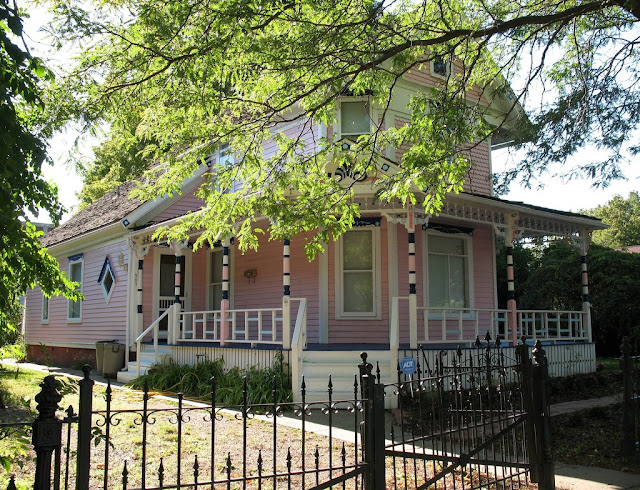
The Charles W. Nash house in Flint.

Ron Fonger of Mlive reports
The former Flint home of Charles Nash, co-founder of Buick Motor Co. and former president of General Motors, is for sale, but the historic structure won’t necessarily be sold to the highest bidder.

The Genesee County Land Bank is hosting a showing of the home at 307 Mason St. from 2-6 p.m. on Wednesday, June 28, and attendance is the first requirement for making a proposal to buy, invest in, and preserve the Victorian-style, three-bedroom home that was built in 1890 in the city’s Carriage Town Neighborhood.

Michael Freeman, executive director of the Land Bank, said the Nash house ended up in his agency’s hands after the county foreclosed on it for failure to pay property taxes. The Land Bank is highlighting the home’s availability and accepting proposals from prospective buyers until 4 p.m. July 24.
Readers of Teardown: Memoir of a Vanishing City may remember that this was the house where I stayed when I returned to Flint in the summer of 2009. It was then owned by my friend Rich Bennett, who was instrumental in convincing me to rediscover my hometown. Rich is no longer with us, but his memory and all the things he did for Flint live on. 

Let's hope the new owner of the Nash House treats it well.

My sleeping arrangements at the Nash House in 2009


Laundry day at the Nash House in 2009.


Thursday, September 4, 2008

Improving Flint from afar

The Charles W. Nash House, owned and cared for by Flint Expatriate Rich Bennett, who points out it was pink when he bought it, so he doesn't want any complaints from historic preservationists. (This photo and many other great shots of Carriage Town by sarrazak6881.)


Yesterday's post on out-of-town property owners in Flint looked at some of the negative aspects of absentee investors. It prompted Flint Expatriate Sarah Swart to comment: "I'm wondering if any of these out-of-towners (which, remember, are only one of numerous OOT options, including bank ownership) are actually expats. Personally, I am tempted by the $900 home in Carriage Town and by one on Forest Hill Ave listed for $4,000. I'm not a real estate investor, I'm pro-local and -civic action, and I'm very tempted. "

You're not alone, Sarah. I've been tempted as well. And in the past week I've had the chance to reconnect with another Flintoid who has already taken the plunge. Rich Bennett went to St. Mary's School and graduated from Powers in 1983, so he has deep roots in Flint. He's now a real estate agent in San Francisco and the proud owner of the Charles W. Nash House in Carriage Town, a fine example of Queen Anne-style architecture that's designated as a Michigan Historic Site. He also owns two other Flint properties.

In typical Flint fashion, Rich and I met at a bar, The Latin Amercan Club, to catch up. When we were done discussing the relative merits of the paddle versus the ruler from the nuns at St. Mary's, we talked about Flint real estate. Unlike some absentee owners, he's restoring his properties and working to improve his neighborhood away from home. His sister is local, so she helps him with the projects, and he's hooked into the network of local preservationists, contractors and urban homesteaders. He makes regular trips back to Flint and hopes to eventually rent some of the properties. But right now the goal is improving them.

"It's seems like Flint's leaders have always been looking for one big project to fix everything — Autoworld, Water Street Pavilion, Windmill Place," he said. "Flint is going to improve with a lot of small efforts all added together."

Rich's effort is buying a few houses, fixing them up, and making them an asset, rather than a detriment, to the neighborhood. The fact he's in San Francisco doesn't matter much at this point. He's improving Flint from afar. It's an approach more absentee owners should take to heart. It's also the approach many local property owners could embrace. After all, the majority of Flint's slumlords are probably local.