Showing posts with label Teardown: Memoir of a Vanishing City. Show all posts

Friday, February 13, 2026

Charting Decline on a Flint Street with Google Street View

It's easy to explore my old Civic Park neighborhood in Flint via Google Street View. Twenty years ago, the experience was more nostalgic than distressing. A digital trip down memory lane. 2402 Bassett Place and the neighboring house at 2406, once owned by the Bowden family, looked pretty much the same, even though the surrounding blocks were already in serious decline. But it was only a matter of time before Bassett Place caught up with the rest of Civic Park. 


AUGUST 2008

The crack down the middle of my old driveway has widened, reminding me of Andy Goldsworthy's Drawn Stone installation at the de Young Museum in San Francisco, though it obviously draws far less attention and adoration. Otherwise, the two houses look much like they did when I lived on Bassett Place in the 1970s and '80s. The low-resolution image helps hide the fading paint and less-than-pristine yards, but there would be no real cause for alarm if I drove down the old street in 2008.


JUNE 2011
A sunny day and higher resolution make the two houses look even better almost three years later. The pine and the chestnut trees provide some welcoming shade.


SEPTEMBER 2015
Just four years later, and it's all over. Both houses are boarded up. The screened-in front porch where my family gathered in the summer to watch baseball games across the street in Bassett Park is open-air now. The siding has been stripped from my childhood home, reverting back to the original minty green. 


JANUARY 2022
Almost seven years later, and the boards on the windows and doors of the two houses appear to be doing their job. The two structures look more or less the same in this winter scene. A closer look reveals that our old garage is a shell — the door is gone and there are large holes opening in the back. And the small white house to the south — once owned by the Procuniers and then the Kildees — hasn't survived. It's gone.


JUNE 2025
The houses are slowly returning to nature by summer 2025. The tall grass and encroaching shrubbery make it seem less bad and more of a natural progression. At least things are growing instead of rotting away. (Of course, the Google car may have cruised by between mowings by the city or the land bank, but if the decline is inevitable, at least it appears green and vibrant in what could be the last google images before these two abandoned houses disappear forever.)


Wednesday, September 17, 2025

The Art of Deception


Flint, as you've never seen it before, perhaps as imagined in a drug-induced haze, on Etsy


Saturday, February 15, 2025

Flint Postcards: All the schools have been closed this week so the kids don't get frostbite


With postcards like this one, Gary is clearly not suited for employment with the Flint tourism board.


Monday, November 20, 2023

Inescapable Landscapes


Flint Expatriates
1515 Illinois Avenue, Flint, Michigan.

"We can’t help ourselves. We are shaped by the landscapes we are born to as inescapably as any other earthly creature born to any other ecosystem."

Margaret Renkl in the New York Times


Thursday, June 29, 2023

Charles W. Nash House For Sale

The Charles W. Nash house in Flint.

Ron Fonger of Mlive reports
The former Flint home of Charles Nash, co-founder of Buick Motor Co. and former president of General Motors, is for sale, but the historic structure won’t necessarily be sold to the highest bidder.

The Genesee County Land Bank is hosting a showing of the home at 307 Mason St. from 2-6 p.m. on Wednesday, June 28, and attendance is the first requirement for making a proposal to buy, invest in, and preserve the Victorian-style, three-bedroom home that was built in 1890 in the city’s Carriage Town Neighborhood.

Michael Freeman, executive director of the Land Bank, said the Nash house ended up in his agency’s hands after the county foreclosed on it for failure to pay property taxes. The Land Bank is highlighting the home’s availability and accepting proposals from prospective buyers until 4 p.m. July 24.
Readers of Teardown: Memoir of a Vanishing City may remember that this was the house where I stayed when I returned to Flint in the summer of 2009. It was then owned by my friend Rich Bennett, who was instrumental in convincing me to rediscover my hometown. Rich is no longer with us, but his memory and all the things he did for Flint live on. 

Let's hope the new owner of the Nash House treats it well.

My sleeping arrangements at the Nash House in 2009


Laundry day at the Nash House in 2009.


Wednesday, June 28, 2023

That's My Moon over Court Street: Dispatches from a life in Flint by Jan Worth-Nelson.


The essence of Flint is too often defined by outsiders. Journalists, politicians, and policymakers love to swoop in, make dire pronouncements and tenuous promises, then skip town faster than General Motors. My friend Jan Worth-Nelson is just the opposite. She moved to Vehicle City for a job, put down roots, and made it her home. That doesn't happen too often these days. Her highly nuanced relationship with a place that's hard to love is captured in these pages. She details Flint's struggles with compelling, clear-eyed prose but still manages to pinpoint what makes it unique, admirable and, yes, appealing despite all the heartache attached to this troubled spot on the Michigan map.

Here is the introduction to her new collection of essays, That's My Moon over Court Street, which is essential reading for anyone who wants to understand Flint and everything it represents.


When I arrived in Flint at the start of the '80s, I was already 30, never married, a broke social worker and former journalist, desperate for evidence my life wasn't wasting away. 

I never, ever, thought I would still be here 42 years later. But here I still am.

I lived in a walkup on Avon Street, which crosses Court Street, the main east-west
artery through the heart of the city. It was a down-at- the-heel old neighborhood, tucked
between an ugly freeway and artifacts of Flint’s glory days: sprawling brick high school,
library, art museum, planetarium. On the other side of Court, a big green park and a
fancier neighborhood which seemed unreachable.

From my upstairs dormers many nights I used to see a mysterious bearded man on a
bike slink out in the moonlight and disappear.

I eventually found out that figure was Gary Custer, founder and publisher of the little magazine that appeared on my own doorstep every month. East Village Magazine is a
scrappy little black-and-white publication that has been landing on the doorsteps of
homes, shops, and restaurants in Flint, Michigan, since 1976. Some of us rudely called
it the “East Village Idiot.” But as I learned over the years, Custer was anything but.
A Vietnam-era Navy veteran, Gary had graduated in photojournalism from the
University of Missouri. He often cited ideas about the Global Village -- he was crazy
about Marshall McLuhan. For him, that meant a passion for neighborhood preservations
efforts, and, while he sometimes seemed reclusive, he had a commitment to train
volunteers and students in community journalism.

He never married and never had any kids. His untamed long white beard made some
people wonder if he was homeless -- but he wasn’t. His apartment in a big Victorian
house was a short bike ride to the office -- a storefront owned by his brother that bore
no sign, no hours, and was frequently locked.

Sometimes, nursing a pipe, he worked at the office all night, hammering away in the
midst of a firetrap tunnel of piled-up folders, books, old copies, on a succession of hand-
me-down computers, piecing together the eight-page product that was, I think it is pretty
safe to say, his whole life.

East Village Magazine focuses on the kind of journalism that matters to every citizen
who cares about what is happening in their town. Over the years that included news
from City Hall, city council meetings, the school board, zoning issues, blight elimination,
crime, healthcare, local politics, and neighborhood associations. And, because it is in
Flint Michigan, the abandonment of Flint by General Motors, the State-appointed
“emergency manager,” and, of course, the Flint water crisis.

But Gary always included a story that described everyday life in Flint. He showed us
that no matter what was going on at City Hall, people continued to live their lives. He
called it “Village Life” as a nod to McLuhan.

Eventually he found some of my writing here and there and, after another back page
columnist left, he asked me to join in. I said no for several years.

When Gary finally snared me to write the column, I was already well into middle age,
and the inexplicable survival of the little magazine had become almost legendary. By
then I lived in my own house, miraculously in that leafy historic neighborhood on the
south side of Court I had envied decades before. I am still there.

These are not the essays of a young person, though I was often playful. I didn’t feel my
age; I was furiously emerging from a long- failed marriage and launching a new one,
and I was half-pissed all the time at not getting enough respect in my university job.
Writing the column was freeing and cathartic.

Gary was a cantankerous editor, and he and I used to fight about words. He was a
subject-verb-object man. I liked words like lachrymose and duende -- not to be a
showoff, I insisted, but for the pleasures of it. I was teaching my poetry students to write
sestinas and pantoums, for chrissake. He stood for simple sentences and he worried
about the reader. I wanted to take the reader along with me. The job was to write “local,”
and he liked best when I observed my daily life - the kind of sensory detail, beloved or
troubled specifics, that kept us both going through our ups and downs.

In the end, he let me write pretty much whatever I wanted. That was the gift of it. At first
he told me to write 800 words so it would fit on the back page. But when I had more to
say he didn’t fight me much -- he said, “Write until you’re done and then stop.” When I
came in, usually on Sunday afternoons, to proof my column, he poured me Bushmills in
a chipped mug, and we would talk about everything -- repeating gossip and legends of
the city, sometimes with the door wide open to the scent of it -- acrid and redolent with
ghosts. A wild rosebush twisted around the fence outside. I have repeated all this so
many times: I cherished those Sunday afternoons.

I never got paid for it, except for the Bushmills. Once in a while he’d send me an email:
“good work.”

Gary Custer died suddenly in 2015, just weeks after he’d learned he got a five-figure
grant from the C.S. Mott Foundation -- enough to keep the magazine going for least
another year. I’d just retired from teaching writing, and so I was free.

For the next five years, I was the editor. I didn’t really want to do it, but I got roped in,
and hacked away grumpily at the financial and technical thickets. My husband, an LA
transplant, faithfully pitched in. We got renewal grants each year. I wrote far fewer few
Village Life columns from then on, getting other people to join in. We expanded the
magazine to 12, then 16, and now often 20 pages.

In 2020, after a series of personal crises, burned out by the Trump era and smothered in
the worst of the pandemic, I stepped back. Though I’ve contributed several columns
since, as I have stated, I was tired of words. I handed the editorial reins to Tom Travis,
who has been ably guiding East Village Magazine ever since.

For years, my second husband and I also commuted back and forth from an apartment
at the LA Harbor, but always, always, I came back to my home in the old house off
Court Street, where my life, familiar and beloved, proceeds. What I wrote about it, even
when I was perched on the lip of the Pacific, always seemed to turn to Flint. My roots
have gone down deep.

I have a lot of friends here, people as enmeshed in complex life journeys as me, and I
love that so many of them have tolerated appearing in my columns.  If you are looking
for evidence of advocacy or political analyses, this collection is not for you. Throughout,
my inclination was not to "promote" Flint or offer arguments or solutions to its repeated struggles.  What I had to offer, instead, were my eyes and ears and my heart, put together in collages of what I hope are decent sentences and respectful stories -- a palette of dramas, small and large, collected one by one, from my own life in this place. 

In 2018, I got myself my first (and only) tattoo. It’s a semicolon – to me, a powerful
reminder that there is so often so much more to a story – certainly true in my life, and
absolutely true in Flint, Michigan. At about the same time, I inherited a Buddha from the
back yard of my beloved friend, the late poet Grayce Scholt. The Buddha is missing its
right hand. I don’t know the story of how that damage occurred, but I do know that the
broken Buddha, who now sits quietly in my own back yard, still retains a big broad
smile. It has become a cherished symbol, for me, of incongruous joy and of the
community that has become my home.

My adult life in Flint has had some dark times, and I haven’t been spared from hard and
stupid things. These essays describe the improbable happiness I have found so often
here. How could that happen in a town like this, even through some of its toughest
times? These columns, one by one, represent a kind of answer, the vindication of
claiming my life in this complicated city: to look at it, to love it, sometimes to despair
about it, and to write it into the cornucopia of our collective human lives.

— Jan Worth-Nelson


Monday, September 12, 2022

Flint's city clerk resigns before November elections

November elections in Flint and Genesee County just got a lot more complicated.

Steve Carmody of Michigan Radio reports:

Flint’s long-time city clerk is resigning, and that’s throwing the city’s plans for the November election into disarray.

Inez Brown has been Flint’s city clerk for 25 years. But at Wednesday night’s city council meeting, Brown announced she would be stepping down at the end of the month.

“I want you all to know how much I appreciate this opportunity to work for my hometown,” Brown said.


Brockmire and Flint: An endless parade of suffering with no one offering any help


Friday, June 24, 2022

The Best Non-Fiction Flint, Michigan: Books about the past, present, and future of American cities


If you're looking for the heart, humor, and, at times, horror of Flint, Michigan — and cities like it all over the country — look no further than these five non-fiction books.


I was assigned to the Cab Shop, an area more commonly known to its inhabitants as the Jungle. Lifers had told me that on a scale from one to ten — with one representing midtown Pompeii and ten being then GM Chairman Roger Smith's summer home — the Jungle rates about a minus six.

"It wasn't difficult to see how they had come up with the name for the place. Ropes, wires and assorted black rubber cables drooped down and entangled everything. Sparks shot out in all direction — bouncing in the aisles, flying into the rafters and even ricocheting off the natives' heads. The noise level was deafening. It was like some hideous unrelenting tape loop of trains having sex. I realized instantly that, as far as new homes go, the Jungle left a lot to be desired. Me Tarzan, you screwed.


Teardown: Memoir of a Vanishing City by Gordon Young
I was headed to a vacant house owned by a friend of mine named Rich. Like me, he had grown up in Flint and eventually moved to San Francisco, where we met. He owned three “investment” properties in Flint, although the fact that all of them were empty indicated they weren’t exactly generating a lot of income. He had happily agreed to let me crash at one of them. “It’s good to have it look like there’s someone actually living there,” he had told me. “It keeps the thieves from steal­ing the plumbing.” 
It took me a while to find the house because downtown still had an inexplicable number of confusing one-way streets, an unnecessary rem­nant of the days when growth and good fortune meant traffic congestion. I’d also never spent much time in the Carriage Town neighborhood. It was unfamiliar terrain when I lived in Flint, a neighborhood to avoid unless you were in the market for drugs, hookers, or an ass kicking. 
Rich’s sister, Berniece, was there to greet me when I finally arrived. She still lived in Flint. Although we’d never met, she showed me around the house like I was an old friend, presenting a very practical house­warming gift—a four-pack of toilet paper. She seemed worried about me, offering advice like “Don’t let anybody you don’t know into the house” and “Be careful who you talk to on the street.” I tried to reas­sure her that I knew how to take care of myself. I was from Flint, after all. But I sensed that my San Francisco pedigree, the new Patagonia shirt with lots of snaps and pockets that I’d bought for the trip, and my teal-striped Pumas were undermining my street cred. 
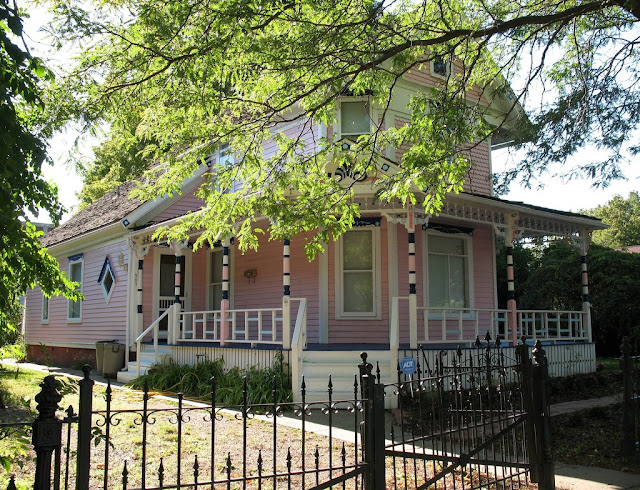
Before I try to pawn myself off as a minor-league George Orwell writing a Rust Belt version of Down and Out in Paris and London, I should point out that Rich’s house wasn’t as rundown as many in the neighborhood. It was the well-preserved former home of Charles W. Nash, the president of GM in 1912 and founder of Nash Motors. It was just across the street from the Durant-Dort Office Building, the beautifully restored birthplace of GM. Unlike many of Flint’s empty structures, the Nash House had luxuries like plumbing and electricity. The water heater was broken, but a cold shower would be better than nothing. Inexplicably, the place was painted pink, destroying any chance I had of establishing myself as some kind of tough-guy writer, a Buick City Bukowski. 
The wood floors, wraparound porch, handsome stained glass win­dow, and high ceilings oozed Victorian charm. There was no sign of habitation other than an awkwardly modern glass table in the dining room, a couple of folding chairs, and an expensive-looking Persian rug in the living room. Our voices echoed in the empty space. The bulk of the tour was devoted to the house’s four doors and eight locks. The kitchen door had been nailed shut from the inside with a two-by-four after a break-in. The side door was locked and seldom used. If there was a fire, Berniece advised, the front door was my best option, other than the windows. 
“I’ll try not to burn the place down,” I joked. 
“It’s not you I’m worried about,” she answered. Like any city with a lot of abandoned property, Flint houses regularly went up in flames. 
I decided to bed down on the nice rug. Besides adding a little padding, it was close to the fire exit. 

But on November 4, Americans are taken hostage in the U.S. Embassy in Iran. I fold my papers and stare at pictures of blindfolded Americans. I don't connect the dots. Then, two weeks later, in the middle of a November night, Dad calls from the officers' club in Subic Bay. Mom says he wants to talk to me. I rub the sleep out of my eyes and cradle the phone. He says he's sorry. The boat is being turned around, off to the Persian Gulf, as a show of strength. I don't know what that means. I just know there will be no trip to Hawaii. 
Dad's letters continue to arrive from somewhere in fits and spurts. They used to be marked on the back with the number of days until his return. Now he just circles the seal on the envelope with a question mark and an unhappy face. 
Soon, it's the morning of November 28. Mom sleeps in; Chrissie has been up with the croup. By 11 am, I'm trying, unsuccessfully, to skate backward at the Roller Barn for eighth-grade gym class. I can tell you the electoral-college breakdown of the Carter-Ford presidential election and the status of Kenny Stabler's wobbly knees, but when it comes to the things that confer acceptance upon boys – hitting a baseball, building a catapult for Webelos, roller-skating backward – I'm hopeless. I need someone to show me how, someone to tell me that it really doesn't matter anyway. But that man is always 8,000 miles away. 
So I fall on my ass. The cool kids snicker. My gym teacher calls me over. I'm relieved at first because it stops the laughing. But the teacher's permanently upbeat face has gone flat. She points to a man standing by the snack bar. He wears a black uniform and carries a white hat in his hand. It is Lieutenant Commander Laddie Coburn, Dad's best friend. I slowly skate over and sit down on a bench. He hesitates, sits down next to me, and puts a hand on my knee. 
"Your father has been in an accident."


The Poisoned City by Anna Clark
In the first full account of this American tragedy, Anna Clark's The Poisoned City recounts the gripping story of Flint’s poisoned water through the people who caused it, suffered from it, and exposed it. It is a chronicle of one town, but could also be about any American city, all made precarious by the neglect of infrastructure and the erosion of democratic decision making. Places like Flint are set up to fail—and for the people who live and work in them, the consequences can be fatal.
Through a series of disastrous decisions, the state government had switched the city’s water supply to a source that corroded Flint’s aging lead pipes. Complaints about the foul-smelling water were dismissed: the residents of Flint, mostly poor and African American, were not seen as credible, even in matters of their own lives.
It took eighteen months of activism by city residents and a band of dogged outsiders to force the state to admit that the water was poisonous. By that time, twelve people had died and Flint’s children had suffered irreparable harm. The long battle for accountability and a humane response to this man-made disaster has only just begun.


Thursday, November 9, 2017

Body Language

Gordon Young Journalist

Love this photo. Jake May of MLive captures the "warm rapport" Lt. Gov. Brian Calley, left, and U.S. Rep. Dan Kildee, D-Flint Twp. must share with each other with this photo taken at the grand opening of the Ferris Wheel building on Saginaw Street in downtown Flint. You don't have to be a body language expert to figure this one out.

On a side note, I'm with Kildee on the clothing choice. If you're going to wear a suit, wear a tie. Otherwise, why bother?


Thursday, July 10, 2008

The end is near

(Photo by Rashaun Rucker of The Detroit Free Press)

Demolition has begun on Tiger Stadium. Bill McGraw of The Detroit Free Press reports:

"Amid the dust and bulldozers and roving bands of middle-aged men with cameras on the first real day of demolition at Tiger Stadium on Wednesday, it emerged that the city is planning to save three of the stadium's historic elements -- the flagpole and both foul poles."

Ernie Harwell, who is still fighting to save part of the stadium through the Old Tiger Stadium Conservancy, remembers the good times at the corner of Michigan & Trumbull.